Welcome to the DePaul University Survey Resources page, the best place to find information on surveys at DePaul. From here, you can:
- Learn about the surveys that are being administered to DePaul students, faculty, staff and alumni
- Learn about using Qualtrics - our online survey administration tool
- Find results from previously administered surveys
- Request assistance for conducting your own survey
[+] Resources and Best practices
Initial Considerations
Conducting a survey is more than just having students answer a bunch of questions. There are many things a person interested in surveying DePaul's students, faculty, staff or alumni should consider, including:
- Relevance: Does the survey provide useful information for DePaul's planning purposes? Does it provide useful feedback to those providing services to students? Does it provide the University with useful information on the experience of DePaul's students?
- Content and Design: Is the survey designed well? Is the content appropriate? Does it follow sound survey methods and practices? Is it of appropriate length? Are the questions easily understood and interpretable?
- Population and Sampling Methodology: What is the target population? Will the entire population be surveyed, or a sample? If the latter, what is the sampling methodology and is it sound? If the former, is a sample an option that should be considered to lessen the burden on students?
- Timing: When will the survey be conducted? Does it overlap with other student surveys? Is it conducted at a time during the academic year when students are likely to respond?
- Dissemination and Use of Information Collected: Who will have access to the information collected and how will they use it? Will it be presented to the President, Provost, Vice-Presidents, Deans, Directors, and/or other line managers who might be better informed in making decisions related to students as a result?
- Protection of the data and information: How will the student responses be secured to comply with FERPA and other policies?
- Overall Impact: What will be the impact of the study? Will the study negatively impact the University? Does the survey overburden students? Does the survey divert important University resources away from other more important projects?
Use the links on this page to learn more about survey design (writing questions, methodology, sampling, and disseminating your results). If you have any questions or need assistance with any of these areas, please contact Liz Holder or Jackie Cameron.
Using Qualtrics Survey Software
Provided here is a series of documents outlining the steps required to perform some of the basic functions in Qualtrics. Note also that Information Services has put
together a page with links to Qualtrics training videos and more that you can access here.
If you have more specific questions about using Qualtrics, please contact Liz Holder or Jackie Cameron.
-
How do I log into Qualtrics?
- Instrumentation
- Panels
- Distribution
- Data and Reporting
Writing Questions
In surveys, the questions you ask are typically aimed at measuring some underlying construct or large issue. To understand student satisfaction with DePaul, we have to ask more than just "Are you satisfied with your experiences at DePaul?" Good questions are reliable (provide consistent responses) and valid (correspond to what is intended to be measured).
When writing questions for a survey, one must first consider how the survey is to be administered. Questions asked in one-on-one interviews will be different than those asked online! When writing questions, one needs to consider:
- Open-ended versus close-ended questions
-- Open-ended means free form; the respondent replies as he/she sees fit. Close-ended means a list of response options is provided to the respondent - think in terms of an agreement scale where respondents must choose a response from 1 (strongly agree) to 7 (strongly disagree). Paper-and-pencil (or online) surveys will be comprised of mostly close-ended questions for ease of data coding and analysis. An open-ended question or two are acceptable to provide respondents the opportunity to explain their responses or to provide insight that would not be possible to ascertain in a closed format.
- Forced verses multiple choice questions
-- Most scaled survey items are examples of forced choice questions - the respondent is forced to choose one response, agree or disagree, satisfied or not satisfied - and only one response is accepted. Sometimes, though, you may ask someone to "Check all that apply" to a list of items. In this case, you have a multiple choice question.
- Four, five, or seven point scales
-- Should your scale have a midpoint? How many response options should there be? There are no absolute answers to these questions. Some prefer the use of a four-point scale (i.e., Strongly Agree, Agree, Disagree, Strongly Disagree) to force the respondent to make a choice, rather than to give them the "neutral" option that a five-point scale would include. While some have found a decrease in socially desirable responses using the four point format, others have found an increase in the reliability and validity of the questions when using a five- or seven-point format.
Sampling
While it would be nice to be able to survey every student at the university, that simply is not feasible because of cost and logistical concerns. Plus, we do not want to overburden our students! Thus, we draw samples, or smaller, representative subsets, of the population to survey. How representative a sample is of your population is a function of many factors, including how the sample was drawn, the sample size and the response rate.
There are many ways that we can create a sample of students. Some of the more common ones include:
- Simple Random Sampling -- This is essentially drawing students from a hat. Members of the population are selected one at a time, without replacement - meaning once selected, that individual has no further chance of being selected again.
- Systematic Sampling -- A variation of simple random sampling which is mechanically easier to create. Say there are 8,500 members in your population and you want a sample of 100. Dividing the former into the latter shows that you require 1 of every 85 persons in the population to be included in the sample. A systematic sample would select a random starting point from the population list and then include every 85th individual.
- Stratified Sampling -- When you know some of the characteristics of the population before sampling, you can structure the sampling process to produce a sample that is more likely to reflect the total population than would be produced by simple random sampling. This process is called stratification. For example, say you wanted to compare responses to a survey by the class level of a student. If the population was made up of equal percentages of freshmen, sophomores, juniors and seniors, then a simple random sample would generate roughly equal numbers of each class. However, if there is unequal representation across class levels within the population, sampling within the class levels (or strata) will produce groups of roughly equal size and make comparisons easier analytically.
One of the most common questions asked is how big the sample should be. Really, this boils down to how you plan to analyze the data and what subgroups you will want to consider, along with an estimate of what fraction of the population falls into those subgroups. Most sample size decisions are concentrated on the minimum sample sizes that can be tolerated for the smallest subgroups of importance.
Deliverables
Once the data are collected and analyzed, it becomes time to prepare the report on the survey. There are a multitude of factors to consider when preparing your report and we direct you to the monograph Effective Reporting, 2nd Edition by Liz Sanders published by the Association for Institutional Research in 2009 for more specifics. Suffice it to say, when preparing for the results of your survey to be made public, there are a number of strategies you can follow to ultimately make your report or presentation more effective:
- Make sure the data reported are sufficient, relevant, timely and consistent
-- Answer the appropriate questions and provide information that relates to the questions or issues at hand. Report the data in the same way throughout. Deliver your report in sufficient time for the data to be useful where decisions are involved.
- Know your audience
-- Don't assume your audience knows the intricacies of your data and analytics, or what your statistical procedures mean.
- Distill important findings for your readers
-- To get your points across, think about using one-page briefs that summarize the key findings and refer readers to larger reports. Be concise.
- Practice effective presentation (written and oral) skills
-- Always be mindful of an engaged audience. Consider presenting reports in a Q&A format, include anecdotes and quotes to liven be report.
Frequently Asked Questions
What is the best time of year to survey students?
The answer depends on both the purpose of your survey and the cycle of other university surveys. For example, if you want to ask freshmen about their experiences at DePaul, then you want to make sure they have had enough time to have experiences - waiting until spring term is better than surveying freshmen in the fall. However, there may be other university surveys, like the DePaul Student Satisfaction Survey, that are sent out in the spring. Consult the
Survey Schedule on this website or contact Jackie Cameron for more information.
How do I know if my survey is too long?
No one has ever complained of a survey being too short! You want to ask enough questions to address your topic, but not too many to exhaust your respondents - this is what we call "survey fatigue." We recommend that a typical survey take no longer than 10 minutes to complete. Have someone not involved in your project answer the survey to test the length.
How many students should I survey?
This boils down to how you plan to analyze the data and what subgroups you will want to consider, along with an estimate of what fraction of the population falls into those subgroups. Most sample size decisions are concentrated on the minimum sample sizes that can be tolerated for the smallest subgroups of importance.
Should your scale have a midpoint? How many response options should there be?
There are no absolute answers to these questions. Some prefer the use of a four-point scale (i.e., Strongly Agree, Agree, Disagree, Strongly Disagree) to force the respondent to make a choice, rather than to give them the "neutral" option that a five point scale would include. While some have found a decrease in socially desirable responses using the four point format, others have found an increase in the reliability and validity of the questions when using a five or seven point format.
Have a question you want answered? contact Liz Holder or Jackie Cameron.
[+] Current Student Survey Schedule
| |
| Academic Year 2025-2026 |
| Quarter |
Survey Name |
Population |
|
Cycle |
Contact |
| Fall |
AlcoholEdu for College |
New Freshmen and Transfers |
|
Yearly |
Katy Weseman / BEAM |
| |
Blue Demon Engagement |
New Undergraduate Students |
|
Yearly |
Katy Weseman / BEAM |
| |
Sexual Assault Prevention for Undergraduates |
New Freshmen and Transfers |
|
Yearly |
Katy Weseman / BEAM |
| |
KGSB Brand Equity Study |
Current students, graduates, employers |
|
One Time |
Liz Holder / IRMA |
| Spring |
National Survey of Student Engagement |
Freshmen and Seniors |
|
Every 3 Years |
Liz Holder / IRMA |
| |
Alcohol and Other Drug Safety Survey |
Undergraduates |
|
Every 3 Years |
Katy Weseman / BEAM |
| |
Faculty/Staff Climate Survey |
All Faculty and Staff |
|
Every 3 Years |
Liz Holder / IRMA |
| Summer |
Graduate Student ASQ |
New Graduate Students |
|
Yearly |
Liz Holder / IRMA |
| |
New Freshman and Transfer ASQ |
New Freshmen and Transfers |
|
Yearly |
Liz Holder / IRMA |
| |
| Academic Year 2026-2027 |
| Quarter |
Survey Name |
Population |
|
Cycle |
Contact |
| Fall |
Graduate Student Alumni Survey (Law Alumni Survey separate) |
Graduate Student Alumni |
|
TBD, Dec. |
Liz Holder / IRMA |
| |
Continuing Student Survey |
Continuing UG/Grad and Law Students |
|
Every 3 Years |
Liz Holder / IRMA |
| |
AlcoholEdu for College |
New Freshmen and Transfers |
|
Yearly |
Katy Weseman / BEAM |
| |
Blue Demon Engagement |
New Undergraduate Students |
|
Yearly |
Katy Weseman / BEAM |
| |
Sexual Assault Prevention for Undergraduates |
New Freshmen and Transfers |
|
Yearly |
Katy Weseman / BEAM |
| Winter |
APR Alumni Survey |
Undergradaute Alumni |
|
TBD |
Liz Holder / IRMA |
| Spring |
Sexual Misconduct Campus Climate Survey |
All Students |
|
Every Other Year |
Katy Weseman / BEAM |
| Summer |
Graduate Student ASQ |
New Graduate Students |
|
Yearly |
Liz Holder / IRMA |
| |
New Freshman and Transfer ASQ |
New Freshmen and Transfers |
|
Yearly |
Liz Holder / IRMA |
* Inactive Surveys (contact Liz Sanders for more info)
- Core Alcohol and Drug Survey
- National College Health Assessment
- Financial Wellness Survey
|
[+] Reports and Questionnaires
Student Surveys
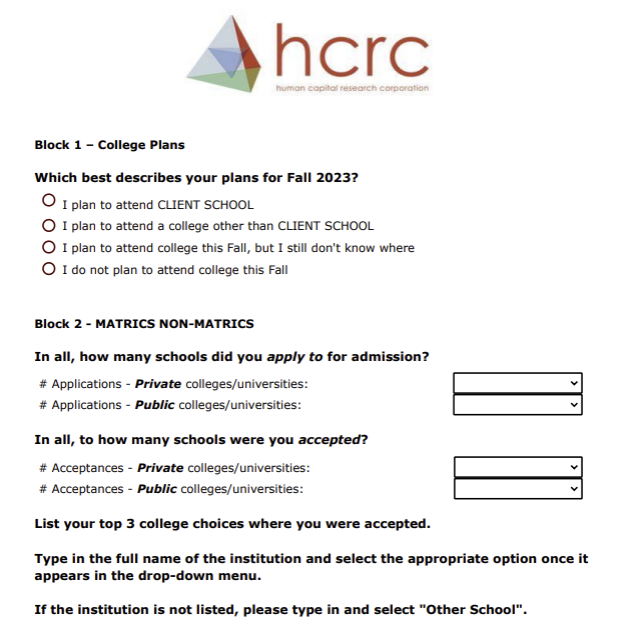
Freshman Admitted Student Surveys assesses incoming freshman perceptions of the college choice process, and how DePaul compares to other schools in the choice set on multiple characteristics.
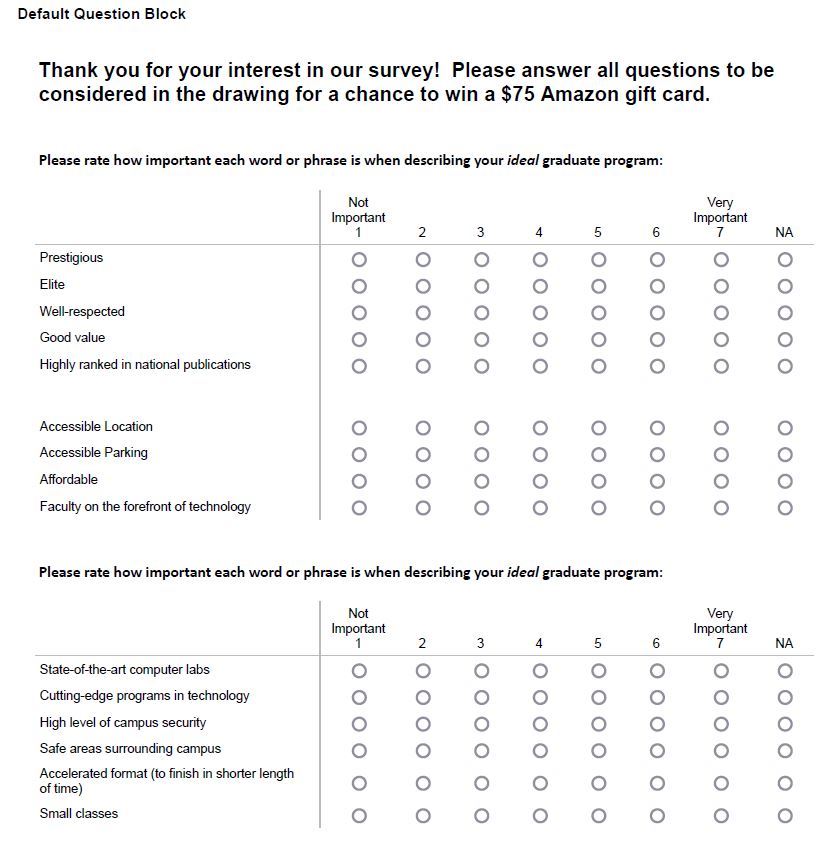
Graduate Admitted Student Questionnaire assesses what incoming master's students consider the most important characteristics of a graduate program, along with perceptions of aid and program offerings.
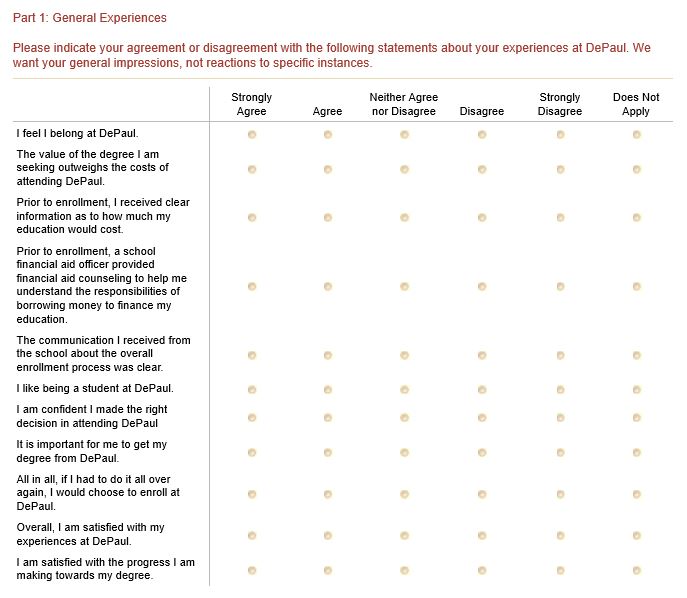
Continuing Students Surveys assesses student satisfaction with their overall and academic experiences, academic advising, career development and campus climate. This survey is administered to undergraduate, graduate and law students.
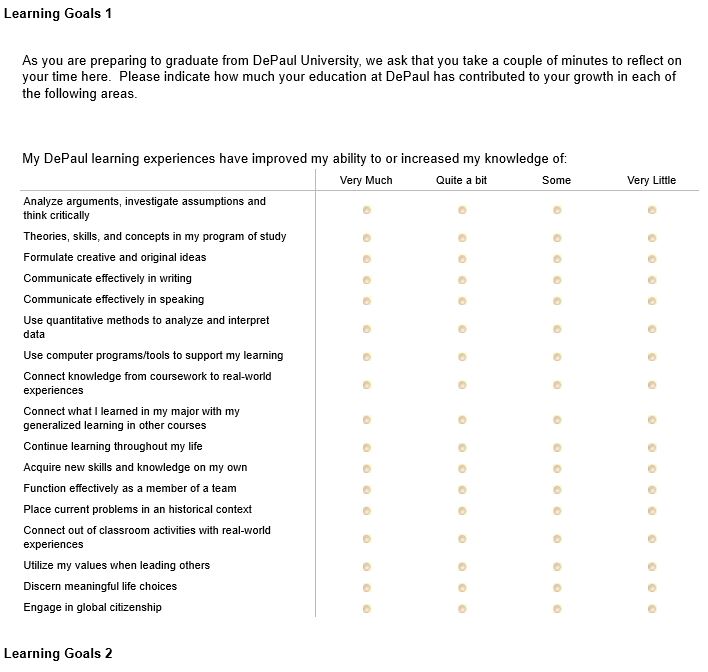
Graduating Student Exit Surveys assess perceived gains in areas related to the university's institutional or programmatic learning goals and satisfaction with university experiences of DePaul's graduating seniors and graduate students. Graduating seniors are also asked about their future employment and graduate school plans.
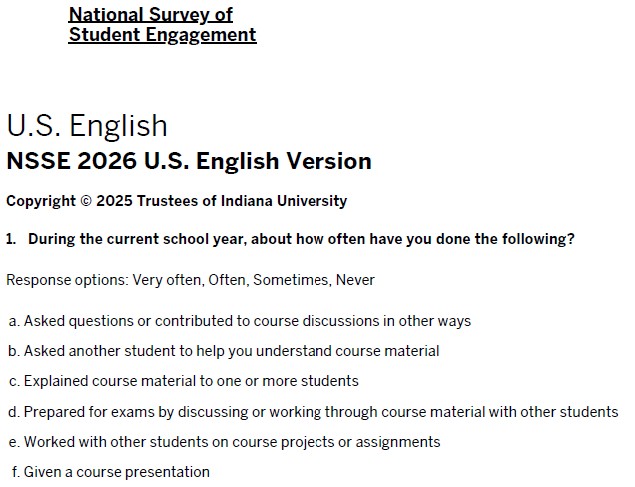
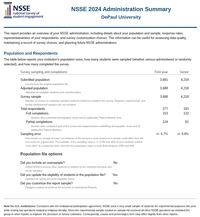
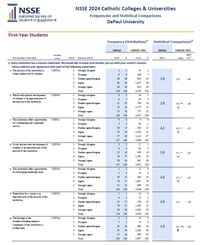
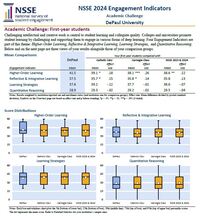
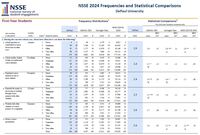
National Survey of Student Engagement (NSSE) assesses the extent to which colleges and universities engage in practices and support environments that contribute to student learning. This survey is administered to first year and senior undergraduates.
2024 NSSE
Administration Summary
2024 NSSE Consortium
Report - Catholic C&U
2024 NSSE
Engagement Indicators
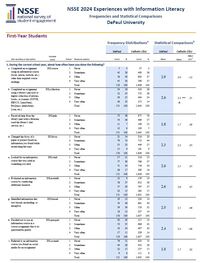
2024 NSSE Frequencies and Statistical Comparisons
2024 NSSE
High Impact Practices
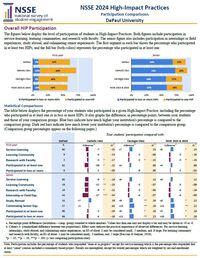
2024 NSSE
Multi-Year Report
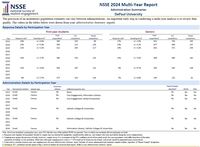
2024 NSSE
Pocket Guide
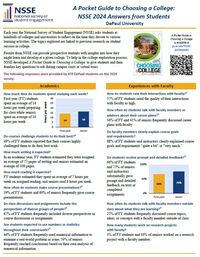
2024 NSSE
Respondent Profile
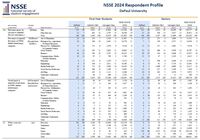
2024 NSSE Selected Comparison Groups
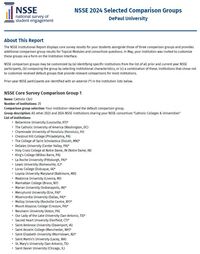
2024 NSSE
Snapshot
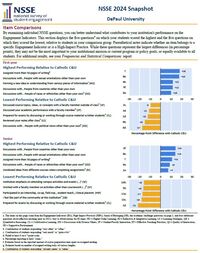
2024 NSSE
Topical Module
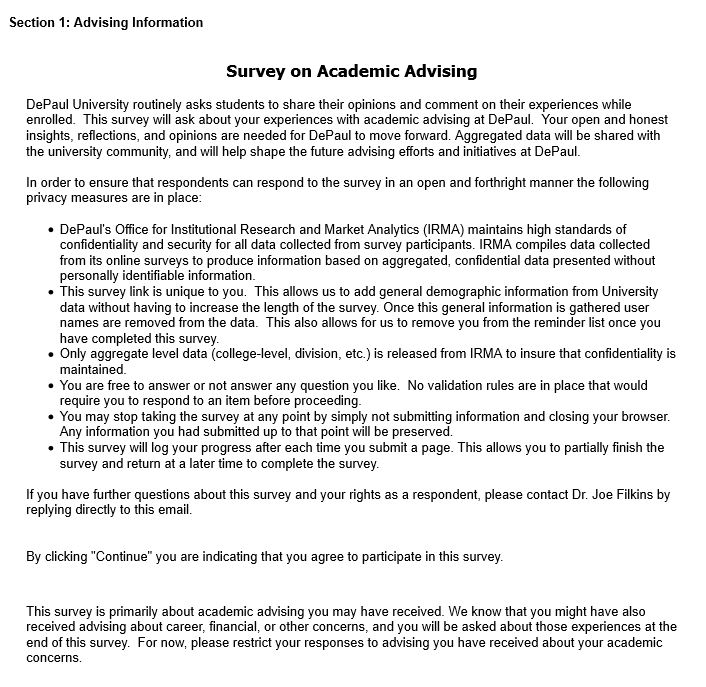
Advising Survey assesses students' perceptions of their advising experiences in terms of needs and satisfaction with the advising process. This survey is administered to undergraduate students.
UG Student Advising Survey
Undergraduate Advising Survey 2022 Recap
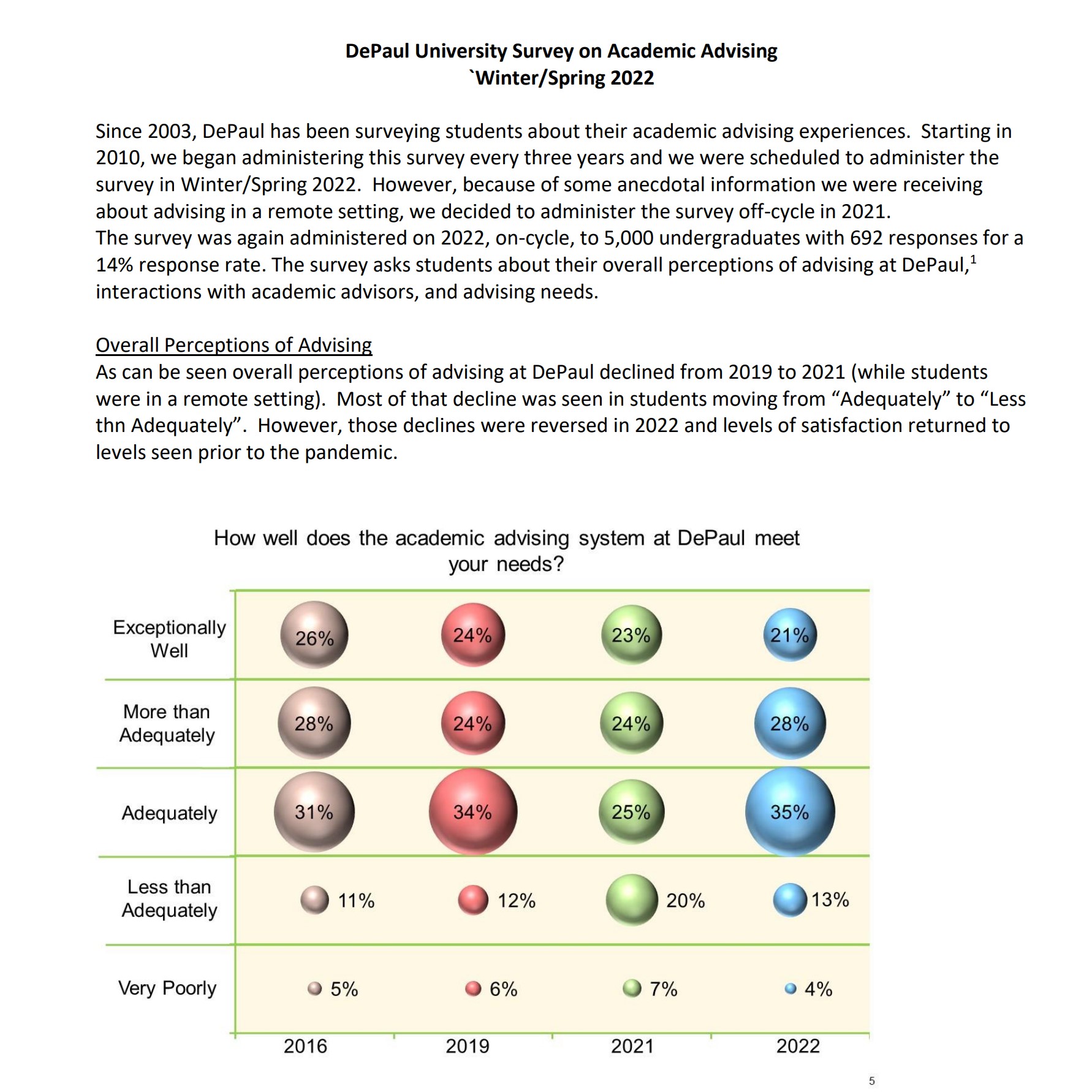
Find additional reports about student perceptions on the Student Market Matrix page.
Faculty and Staff Climate Surveys
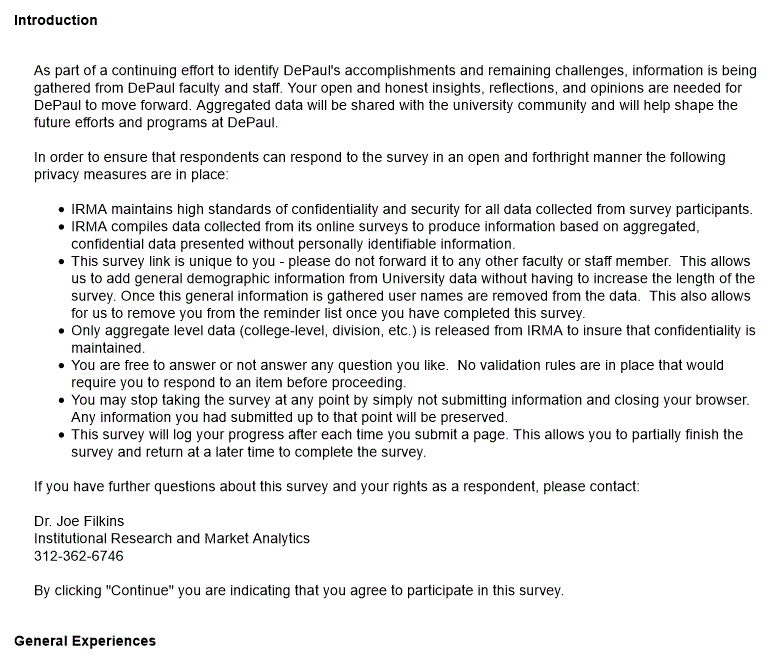
The DePaul Faculty and Staff Climate Surveys are fielded every three years. These surveys support university planning and management.
2022 Full-Time Faculty Climate Survey
2022 Staff Climate Survey
2022 Part-Time Faculty Climate Survey
2022 Faculty Climate Survey Data Tables
2022 Staff Climate Survey Data Tables
Career Outcomes and Alumni Outcomes Surveys
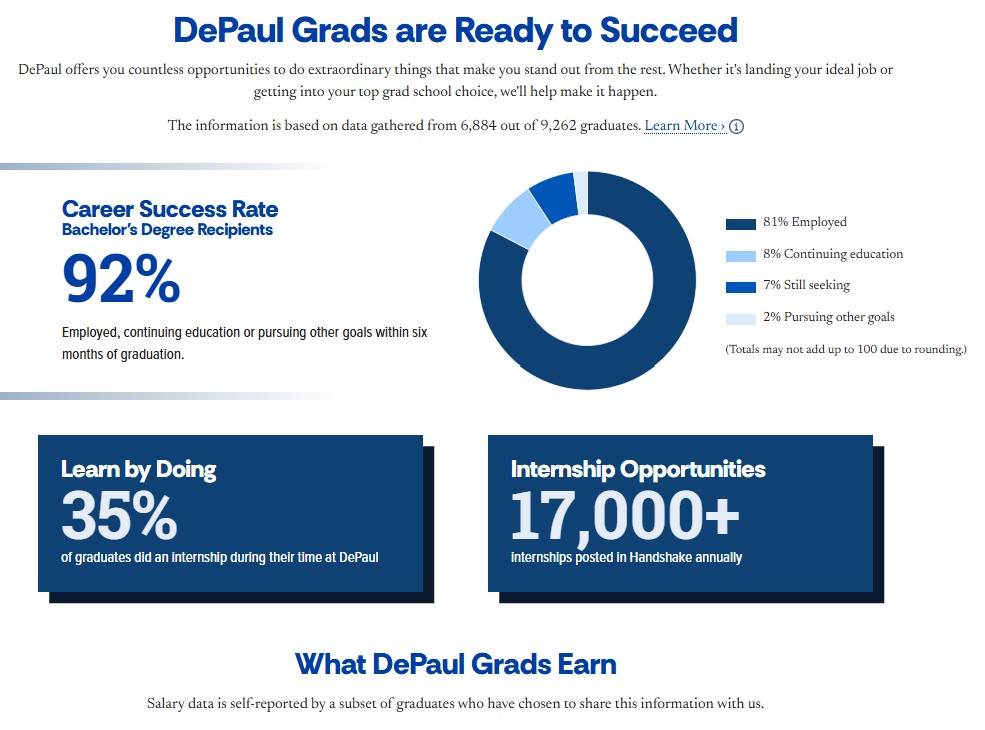
The Career Center surveys graduating classes annually about their post-graduation destinations at graduation and six months after degree completion. Data are also gathered from public record via LinkedIn. Additional information about career outcomes can be found directly on the Career Center Website.
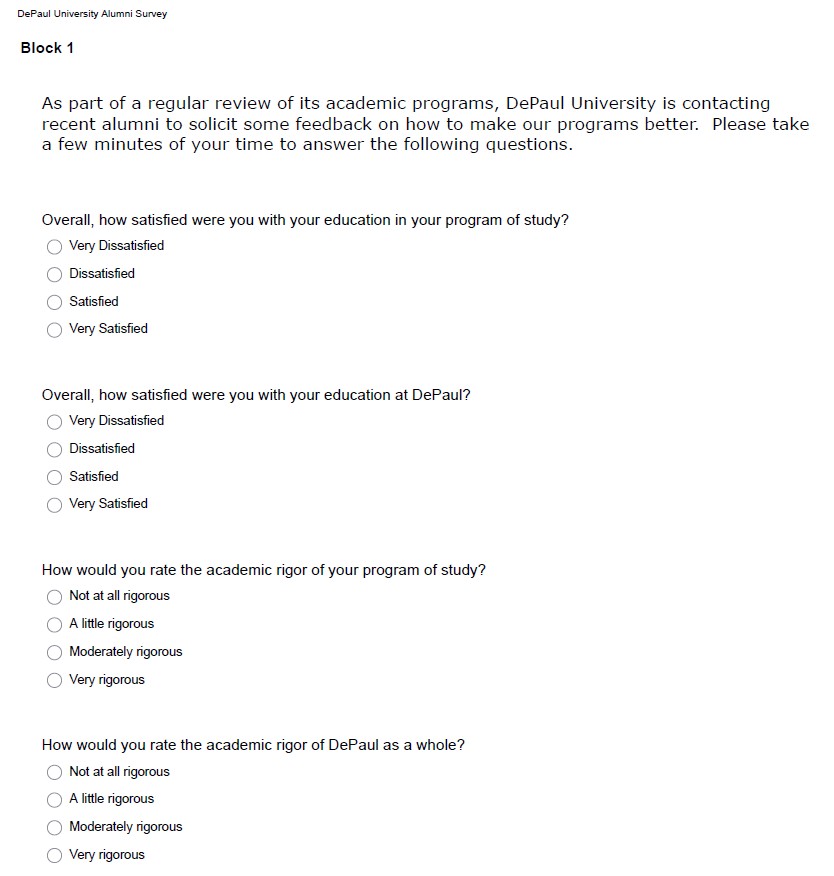
DePaul developed the Alumni Outcomes Survey originally to support the academic units during academic program review and expanded the survey administration in 2009 to include all alumni. This survey assesses the impact of the DePaul education on the personal and professional lives of our alumni. IRMA routinely administers the survey to alumni one-, three-, and five-years out.
Postgraduate Outcomes
[+] DePaul Student Survey Working Group
During the 2007-08 academic year, representatives from the main areas of the university responsible for student surveys (Enrollment and Marketing Research, CRM/Information Services, Institutional Research, Career Services, and Student Affairs), as well as representation from Academic Affairs met to discuss the coordination of all large scale student surveys at the university. The group decided that Institutional Research would continue to be the primary provider of consultation to university constituencies interested in gathering data on students through the use of surveys. The purpose of such consultation includes:
- Assisting in the survey planning process
Consultation on survey methods and design to ensure that survey research is of the highest quality, and that this research produces information that adds value to university decision-making.
- Coordinating the schedule of deployment for student surveys
The creation of a survey calendar to more effectively, strategically, and efficiently support survey research on campus, preventing scheduling bottlenecks and overburdening of particular populations.
- Sharing knowledge on existing data collected from previous and ongoing student surveys of sufficient scope
Review of survey research projects to identify data that may have continued value for university study past the original study, with the informed consent and collaboration of the primary researcher.
Our goal is to increase the quality of the data collected and thereby the value of the information to the university community. We understand that the quality of the data is directly related to the time and effort put into the survey design process.
Please use us a resource for your survey research needs. Our contact information is below. Also, we have created a list of
frequently asked questions, as well as provided information on the
survey administration process.
| For Institutional Research, admission, recruitment, and market-related surveys and services: |
Liz Sanders
Associate Vice President
(312) 362-5289
liz.sanders@depaul.edu
|
Liz Holder
Associate Director
(312) 362-8794
eholder1@depaul.edu
|
For BEAM surveys and projects:
|
Katy Weseman
Data Analyst and Assessment Manager
(312) 362-5644
kweseman@depaul.edu
|
|
|
For IS/CRM surveys and services:
|
Tyneka Harris Coronado
Associate Director, Academic Systems
(312) 362-8451
tharris6@depaul.edu
|
|